marshmallow
Althaea officinalis
This beautiful plant has been in use since ancient Egypt where the root was combined with honey to make candy. In modern times, French confectioneries made the familiar marshmallow treat, pâté de guimauve, while also using an extract of the root. And today, almost lost to food modernization, marshmallow is more likely to be found as a topical in botanical skincare products.
Soft velvet leaves and delightful pinkish-white flowers are an indication of the soothing quality of all parts of the plant for the digestive and respiratory systems. Medicinally marshmallow is protective and brings moisture to the tissues; it is emollient, reducing inflammation and irritation both internally and externally.
-
COMMON NAMES
Marshmallow
-
PLANT FAMILY
MALVACEAE
The Mallow Family
-
NATIVE REGION
Native to Europe and Asia
-
HABITAT
Prefers moist soil in full sun, often found by riverbanks & mashes
-
PARTS USED
Root, leaves, & flowers
-
PROPERTIES
Demulcent, anti-inflammatory, expectorant

PREPARATION
FLAVOR PROFILE: Mild, sweet earthiness
PAIRING: Marshmallow is more about texture than flavor. The root will add body to your teas, syrups, and other liquid extracts. Use aromatic herbs such as mint, angelica, tulsi “holy basil”, and anise hyssop to add flavor while complimenting marshmallow’s effects. Leaves and flowers are also mucilaginous, although less so than the root.
METHOD:
The leaves, flowers, seed pods, and roots are all medicinal.
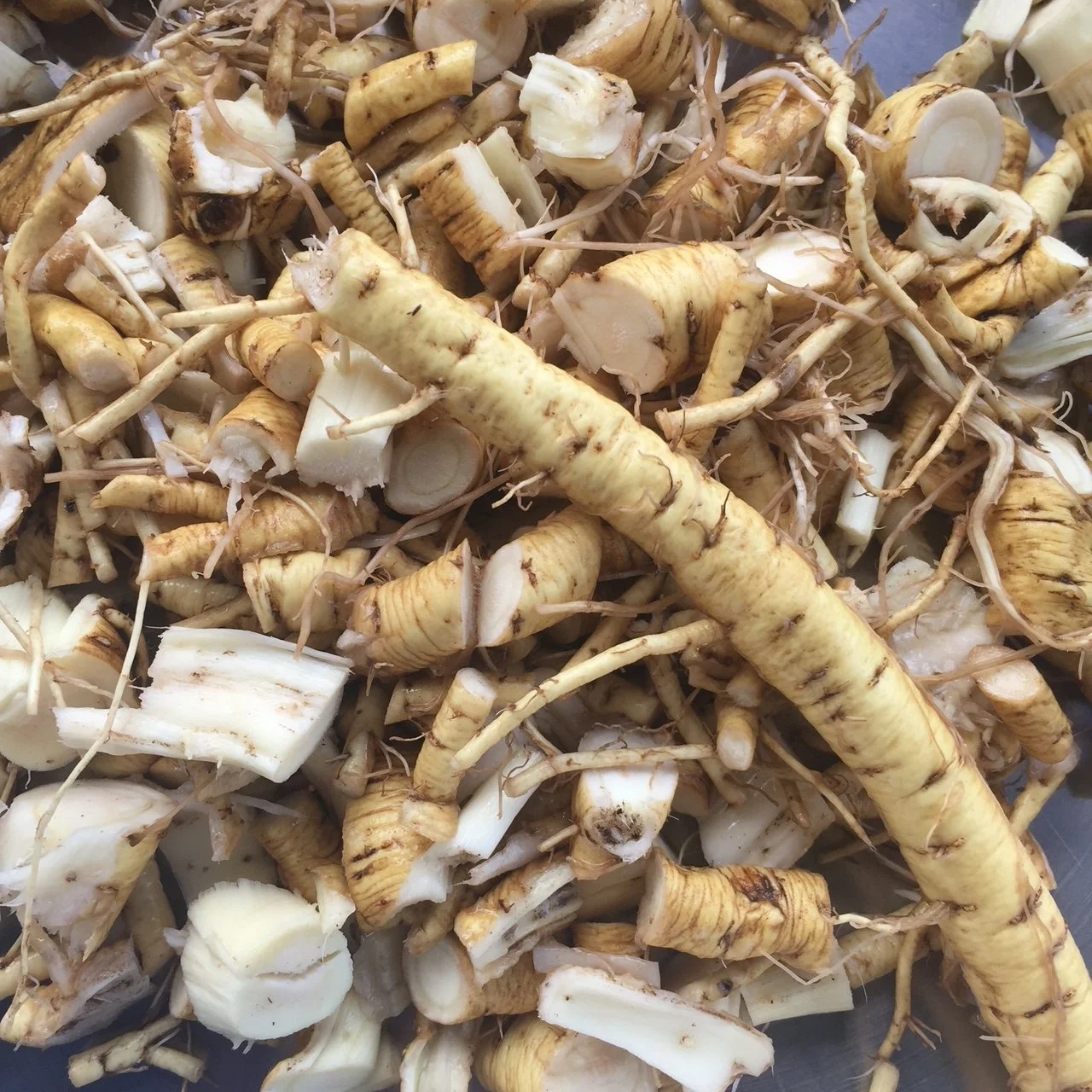
Start by cutting the root off the stem at the crown location, which is the soil level of the plant or juncture of root and stem. Then slice the root into one-inch pieces. The root can be frozen for later or stored in the refrigerator for up to two weeks. Make sure the root is dry as any moisture will encourage mucilage gel to form.
The flowers will last in the fridge for 4-5 days, pull them off and put in a container with a loose bag over top. This retains moisture but still allows air flow.
The leaves and seed pods can be dried, or coated with honey to use later.
The aerial tops (leaves and flowers on the stem) can be kept in a container with water, such as a vase or bucket depending on size, for a week or more.
Mucilage is the main constituent we are trying to get from marshmallow and it extracts best in cold water. It will also extract in honey or maple syrup, but not so well in vinegar or higher % alcohol. The general strategy with marshmallow root is to extract first in water or honey and then add vinegar or alcohol to extend preservation. All parts of the marshmallow plant are a good candidate for drying, however the root will become very hard and difficult to work with unless it’s cut into smaller pieces beforehand. If you’re using dried root, cover in water and soak for 4-6 hours, or until soft, before using the fresh herb recipes below.

-
Making a flavored marshmallow tisane is a two step process; the root must be cold water extracted while most aromatic herbs need to be hot water infused.
To maintain consistency, use a scale to weigh the root.
The ratio is 25 grams fresh marshmallow root to 1 quart of water.
1 pound of roots makes 4.5 gallons of tea.
Measure 1 pint of cold water and add 25 grams fresh marshmallow root. Put in a blender or stick blend to thoroughly shred the root. Cover and let soak for 12 hours. Blend again to break down the root even more now that it has softened. Let soak for 4 more hours. Strain and reserve the liquid. Note: The more you can shred the root the better; check the size of the root chunks, it should look like imitation crab meat or pulled pork. You’ll notice the water thickening and the roots will exude gel, ie. slimy like okra. That’s the good stuff!
Make a pint of tea, such as mint or tulsi, for your flavoring. Add this to the strained marshmallow cold water extract. Shake and serve.
NOTES
You can add your flavored tea while hot to the cold marshmallow liquid without damaging it’s mucilaginous thickening effect. You can also reheat the combined result, finished marshmallow tisane, just do so gently!
Making plain marshmallow is also an option, drink as is or add to other beverages as you like.
Store in the fridge for up to 10 days.
-
Fill a Ball jar with 1” sliced fresh root, and cover with triple the amount of honey. The jar will be 25% root and 75% honey. Let sit overnight.
The next day in a food processor, pulse and process until the root is shredded. Store in the Ball jar and let sit for up to a week outside of the refrigerator. Make sure NO WATER has been introduced in this process. Stir daily, it will take on the consistency of gel (ok, I’ll say it, “snot”!). This is the mucilage coming out of the root. The more you stir the better. If you didn’t get to stir regularly, put in the food processor again.
Get a strainer with medium mesh, not the finest used for powders, but also tighter than a pasta strainer. Cone strainers work great. Pour your honey root extract in and stir, stir, stir, to separate the liquid from shredded root.
Store the liquid part to use as a syrup and retain the root mash to make cold water extracted tea.
NOTE: If you used dried root and re-hydrated with water, pour off any excess liquid and pat dry before adding to honey. I generally don’t like to introduce water to honey syrups as it throws off the sugar ratio needed for preservation and will reduce storage life. To be safe, add 25% vinegar or alcohol to your recipe.
-
Use flowering tops and leaves for a vinegar extract. Discard stems. Chop finely and use 1 heaping tablespoon per 1 oz vinegar; or 1 cup herb per 1 cup vinegar for a 1:1 ratio.
While not completely off the table, an acetract of the root would not be a first choice because the mucilage will not extract well in vinegar.
-
Tincturing marshmallow would not be the best use of this herb because its primary medicinal effect is to coat the lining of the digestive system. Taking drops of a tincture would not produce this effect.
A tincture of the leaves, flower, or root does still have a medicinal effect since there are more constituents in marshmallow than mucilage, and an alcohol extract would capture some of them. So there may be a use for marshmallow tincture.
I am currently writing a section on tinctures to come out with a profile on Ashwagandha root; which is an herb that’s a good candidate for tincturing. If you’re interested in how to tincture Marshmallow, circle back here after the new Tincture section comes out.
-
Best as a cordial to preserve the plant’s mucilaginous properties.
Using MARSHMALLOW ROOT:
Extract the root in honey using the Syrup method above.
Infuse brandy or vodka with an aromatic herb in a general ratio of 1:1. Strain out the herb to retain the liquid.
Combine the marshmallow syrup with infused spirits to desired consistency.
Generally 50% syrup to 50% infused spirits.
Using LEAF, FLOWER, & SEED PODS:
Mix 50% honey with 50% vodka or brandy in a Ball jar.
Add chopped leaf, flower, and seed pod.
Allow to extract for 2 weeks, shaking daily.
Strain and reserve the liquid.
-
Use a dry powder of the leaves, flowers, seed pods, and/or roots.
Put desired amount of powder into a bowl
Add honey by drizzling and stirring until you’ve reached the desired consistency.
Generally a 1:1 ratio by volume
Note: The consistency will harden over time because the liquid of the honey will continue to absorb the powder, and honey eventually crystallizes. If it has become too thick, roll into little balls and dust with a finishing powder (starch, confectioners sugar, cinnamon, another powdered herb, etc.).
-
The leaves, flowers, and seed pods will dry relatively quickly. Lay out in a single layer to allow air flow.
For the root, cut into one inch pieces before laying out to dry. This will make it easier to use later on, as the root will become very hard when dry.
RECIPES

coming soon!
MEDICINAL QUALITIES
-
Demulcent, anti-inflammatory, expectorant -
Starch 37%
Mucilage 11%
Pectin 11%
Flavonoids, phenolic acids, sucrose, and asparagine
-
Marshmallow root, leaf and flower are Generally Recognized As Safe (GRAS) by the U.S. Food and Drug Administration (FDA) for use in foods and in medicinal amounts.
Ingested in large quantities, mucilage can delay the absorption of other medications.

SCIENTIFIC STUDIES
-
2019; Journal of Advanced Pharmacy Education & Research: Althaea Officinalis in Traditional Medicine and Modern Phytotherapy.
2007, Issue 75; Herbal Gram: Herb Profile, Marshmallow.
-
October 25, 2019; Antioxidants: Gastro-Protective and Anti-Oxidant Potential of Althaea officinalis and Solanum nigrum on Pyloric Ligation/Indomethacin-Induced Ulceration in Rats
-
-
2008; Alternative Medicine Review: Natural Approaches to Prevention and Treatment of Infections of the Lower Urinary Tract.
-
March 2015; Avicenna Journal of Phytomedicine. Evaluation of the antibacterial activity of the Althaea officinalis L. leaf extract and its wound healing potency in the rat model of excision wound creation.
“The results showed that although Althaea officinalis L. extract was not effective on gram-negative bacteria but it was efficacious on gram-positive bacteria. The extract was also tested in the form of topical administration on excision wound model in rats. In the extract-treated wounds, the wound healing percent was significantly increased in comparison with controls. Based on this research, herbal extract of officinalis L. can be a great candidate for the treatment of gram-positive infections and merits further studies.”
Examples of Gram-positive bacteria:
Staphylococcus aureus: A common cause of skin infections, pneumonia, and toxic shock syndrome.
Streptococcus pyogenes: Known for causing strep throat and other infections like scarlet fever.
Streptococcus pneumoniae: A leading cause of bacterial pneumonia and meningitis.
Bacillus anthracis: The bacterium responsible for anthrax.
Clostridium botulinum: The source of the botulism toxin, which causes food poisoning.
Listeria monocytogenes: A cause of food poisoning and serious infections in newborns.
Corynebacterium diphtheriae: The bacterium that causes diphtheria.
Enterococcus faecalis: A common cause of urinary tract infections and other bloodstream infections.
Lactobacillus species: Often found in the human gut and are used in various fermentation processes.
Clostridium difficile: A bacterium known for causing severe intestinal infections in hospitals.
-
2020; Complimentary Medicine Research: Marsh Mallow (Althaea officinalis L.) and Its Potency in the Treatment of Cough.
-
2020; Drug Discoveries & Therapeutics: Althaea officinalis improves wound healing in rats: a stereological study.
“Our research shows that AO positively affects the processes of wound healing including angiogenesis, the proliferation of fibroblasts, and the accumulation of collagens.”
-
2013, June; Advances in Dermatology and Allergology: Medicinal plants used in treatment of inflammatory skin diseases.